
The Economics of the Final Frontier
SpaceX, Blue Origin, UAL-you've definitely heard of one of them before. Maybe you've seen their incredibly high valuations. What you might not know is their lofty goals to extract rare resources from outer-space asteroids-read more to find out.
The Economics of the Final Frontier
Space was once the newest frontier for humanity to answer scientific questions, chart new territory, and demonstrate national power. Now, as private companies develop commercial spacecraft and plan to extract extraterrestrial resources, space exploration is as much an economic project as a scientific one. The space industry reached a record size of $613 billion in 2024, a projection that is estimated to climb to $1.8 trillion in the next 10 years. Driving this growth are advancements in technology that decrease costs of commercial launches, create more advanced spacecraft, and allow for autonomous navigation through artificial intelligence. This boom in space capabilities is in part due to increased collaboration between private sector companies and national space programs such as NASA and its Chinese equivalent, CNSA. Both have facilitated booms in space exploration by developing new innovations through resource and technical expertise sharing. With the development of novel technology and the rapid pace that space exploration has taken, a relevant question remains, considering the private sector’s involvement: how will space exploration affect global markets?
Current Economics of Space Exploration
Perhaps counterintuitively, conspicuous space ventures such as mining do not represent a significant share of the space economy's contribution to the larger economy. In fact, a large majority of commercial space activity lies in communications, agriculture, and satellite technologies. In the United States, space activities represented about 0.5% of the national GDP and over 370,000 jobs in the private sector in 2023.
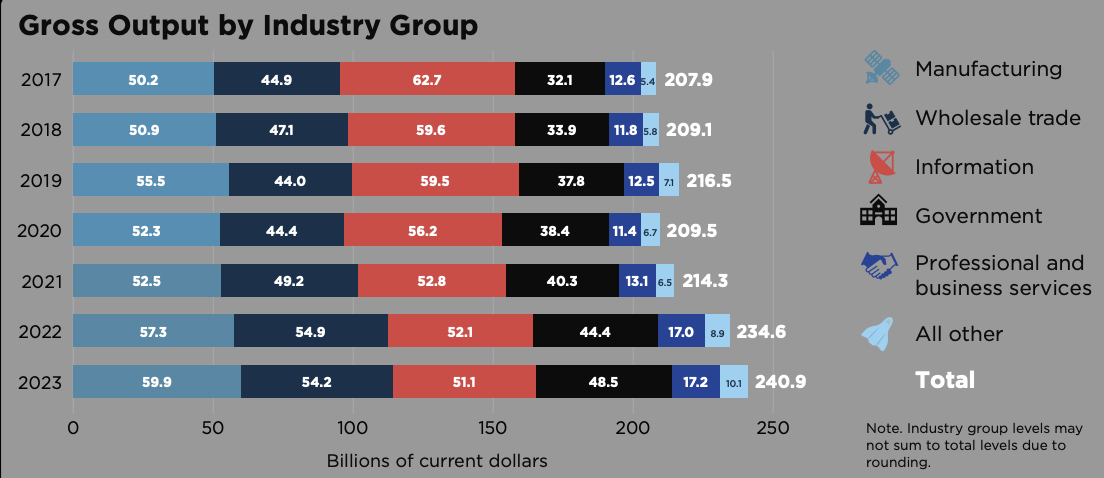
Figure 1. U.S. space-economy gross output by industry group, 2017–2023.
Outer Space Resources
The potential for obtaining vast quantities of precious metals and other important resources cannot be overlooked in any discussion of space exploration and advancement. Take helium-3, an isotope that has been proposed as potential fuel for fusion reactors. It exists on Earth in very limited quantities, making its extraction from outer space a potentially highly lucrative prospect if current theoretical projections pan out. While consensus over the meaning of international law is currently split on the legality of resource extraction from space, United States Public Law does not forbid private individuals from extracting resources from space on a commercial scale, opening the door to a number of private missions. Unfortunately, for any future space prospector, practicality is a more pressing concern. The extreme cost and current minimal returns associated with mining near-Earth asteroids have already discouraged companies from pursuing it seriously. Yet, the prospect of large caches of scarce and incredibly expensive metals is too large for some to not see the value in pursuing the activity.
Economic and Market Effects of Asteroid Mining
Suppose we are successful in extracting the resources from an asteroid such as 16 Psyche, an asteroid that the media once reported to have contained $700 quadrillion worth of gold, and introduce its precious metal to current mining markets, globally valued at fractions of that. This exact scenario has concerned some researchers due to the destabilizing effects that introducing an unfathomable quantity of scarce resources could have. A simulation conducted by Tel Aviv University concluded that one such scenario, beginning with gold prices having already dropped by 50%, would result in conflict precipitated by a global struggle for resources. Intuitively, the very notion of nearly infinite outer space resources challenges fundamental economic concepts like scarcity. Take this example at its most extreme: 16 Psyche and other similar asteroids have been mined and their resources taken back to Earth. An extreme increase in any rare metal’s supply will shift the equilibrium point that determines its price to an astronomically lower number, plummeting the value of that rare metal. At that point, companies may decide that minimal returns from less valuable rare metals aren’t worth the expense and stop producing them once prices fall below production costs.
Why Theoretical Asteroid Values Fall Short
Fortunately for gold suppliers, the aforementioned extreme case using 16 Psyche as an example is more fiction than reality. 16 Psyche demonstrates the problem with media sensationalization of extraterrestrial resources; NASA currently estimates that metal is only 30 to 60% of its volume and cannot reliably determine its composition. The hypothetical also doesn’t consider logistical nuances such as expenses related to transportation, processing, and mining, and the very real possibility that companies will intentionally sit on resources to avoid lowering market prices, a practice used by diamond mining company De Beers to constrict supply. Most importantly, the whole notion of estimating the value of an asteroid in orbit using current prices is methodologically flawed. Current prices depend on scarcity; a deposit worth trillions could destroy its own value the day it’s sold, making the reality of becoming the first quadrillionaire through space mining a pipe dream.
A More Realistic Market
In practice, the most profitable market for extraterrestrial resources may come through outerspace themselves rather than expensive and lengthy transportation to Earth. While transporting materials from space to Earth is expensive, bringing materials from Earth to space is not cheap either, opening the potential for resources extracted from asteroids to be used in space itself. Take water, for example: its necessity in space is almost unparalleled, being utilized for supporting astronauts, radiation shielding, and separated into hydrogen and oxygen to produce propellant. Instead of transporting water from Earth, water found on the Moon or an asteroid could serve as the replacement. In fact, a 2020 study concluded that not precious metals but water is the outer space resource most likely to be economically useful between 2030 and 2050.
What to look out for in the future
Space exploration is no longer hypothetical, especially in the realm of economics, with billions of dollars being undergirded by communications, navigation, manufacturing, and agriculture that all start with space technology. Asteroid mining, while far off and currently infeasible, could upend resource scarcity and disrupt markets, yet heavy expenses related to transportation and extraction stand in the way of such drastic outcomes. More glaringly, sensationalized claims of nearly infinite wealth lying in space rely on flawed notions of value and how markets determine prices. Space resources do have a part to play in future economies, but from a more practical lens, acting as a closer source of materials to support activities in space.
Enjoyed this article?
Subscribe to get the latest economic analysis delivered to your inbox.
Comments
Related Articles

The Most Important Company You've Never Heard Of
You've all heard of AI, and our guess is that you've used it before, maybe even every day. But have you ever sat done and thought about how...

Why Is Everything So Expensive?
From inflation and housing shortages to gas prices and corporate pricing, here's what's really driving the rising cost of living.

The Economics of AI
How will AI impact the world? This article provides a nuanced opinion on the debate that has captivated the attention of millions.