A Mutual Attrition: The Systemic Toll of the US-China Protectionist Race
For decades now, international trade has been seen as a method and measure for global stability, pulling countries like the United States and China into a shared cycle of wealth and innovation. But what happens when a dominant global superpower starts looking at a huge trading partner with deep suspicion? Today, the US-China economic relationship is slowly degrading. This trade war isn’t just about protecting local jobs; it is driven by a deep-seated, mutual paranoia. Both Washington and Beijing are racing to build walls of tariffs and technology bans under the veil of national security. Looking at this conflict as a case study in global economics, it becomes clear that this situation draws a close parallel to the tension between Great Britain and Germany before World War I.1 In both eras, a toxic mix of suspicion and fear fuels a war of attrition, bringing forth a slow, systemic decay.
To understand where this distrust stems from, we have to first look at how established powers react to rising ones. At the turn of the twentieth century, Great Britain was the undisputed ruler of the global free market. However, Germany’s economy was expanding rapidly with the support of government investment and industrial policy.2 British leaders grew incredibly suspicious, fearing that Germany was cheating the system. In 1907, a British diplomat named Eyre Crowe wrote a famous memorandum arguing that Germany's actual intentions didn't even matter: the sheer fact that their economy was growing so large made them a fundamental threat to the British Empire.3 In other words, even if Germany claimed to have peaceful goals, Crowe believed that its economic and military expansion threatened British interests.
A similar tension appears in the United States’ response to China—granted, saying that the United States treats China in the “exact same way” would be overlooking some important distinctions. The US originally supported China’s entry into the World Trade Organization (WTO) and expected that an integrated economy would encourage China to take on more market-based policies and ultimately reciprocate equal benefits. However, when Beijing continued using state subsidies, state-owned enterprises, and industrial planning to build a huge manufacturing base, Washington felt betrayed. Many American politicians view Chinese economic success not as fair competition, but as a hostile attempt to rig the global economy, a challenge to the rules and foundations largely initiated by the United States.4
On the other hand, the rising power often develops an equally deep fear of being contained or trapped. Before World War I, German leaders realized their rapid economic growth made them a target in the eyes of neighboring powers. This led to a powerful fear of “encirclement,” where Germany felt terrified that rival nations were actively teaming up to box them in and destroy their economy.5 To break out of this perceived net, Germany became increasingly aggressive, adopting policies to challenge British dominance further, confirming suspicions among its rivals. Beijing suffers from the same strategic encirclement nightmare today. When Chinese leaders see US tariffs, semiconductor bans, and American military alliances forming with nations in the Pacific, they suspect a coordinated plot to choke off their growth.6 Because both sides view each other entirely through this lens of suspicion, economic policies stop being mutually beneficial and start being about basic survival, locking both nations into a prolonged stalemate that gradually exhausts their own resources in hopes of “saving the nation.”
However, this comparison to prewar Britain and Germany has limits. Unlike those powers, today’s United States and China possess nuclear weapons, making direct war potentially catastrophic. Nuclear deterrence forces much of the competition into tariffs, technological restrictions, cyber operations, and military alliances. The deeply interconnected economies suffer mutual disruptions when restrictions are set against one country.
China produces close to 30 percent of the world’s manufacturing output, compared with 17 percent of the United States.7 However, American semiconductor controls are not officially intended to reverse China’s entire manufacturing edge. The U.S. Department of Commerce describes them as national-security measures targeting advanced computing chips, supercomputers, and semiconductor-manufacturing equipment that could support China’s military and surveillance capabilities.8
Yet China may still interpret these controls as part of a broader effort to limit its development. Advanced chips support commercial artificial intelligence, scientific research, and industry. Therefore, even controls aimed at national security may be seen as intentional limitations. This difference between American intentions and Chinese perceptions only strengthens the cycle of suspicion.
Washington has recently intensified these restrictions, raising tariffs on Chinese electric vehicles to 100 percent, semiconductors and solar cells to 50 percent, and many batteries, critical minerals, and steel and aluminum products to 25 percent. The broader results of these strategic measures attempting to protect critical American industries from heavily subsidized Chinese competition have been mixed. From 2018 to 2021, Section 301 tariffs reduced affected imports from China by 13 percent, but increased U.S. production by only 0.4 percent and domestic prices by 0.2 percent. U.S. importers also paid nearly the full immediate cost of the tariffs. In semiconductors, imports from China fell by 72.3 percent, while U.S. production rose by 6.4 percent and prices rose by 4.1 percent.9 These results together show that tariffs can reduce dependence on China, but they also raise costs and may shift supply chains to other countries rather than bring production back to the United States.
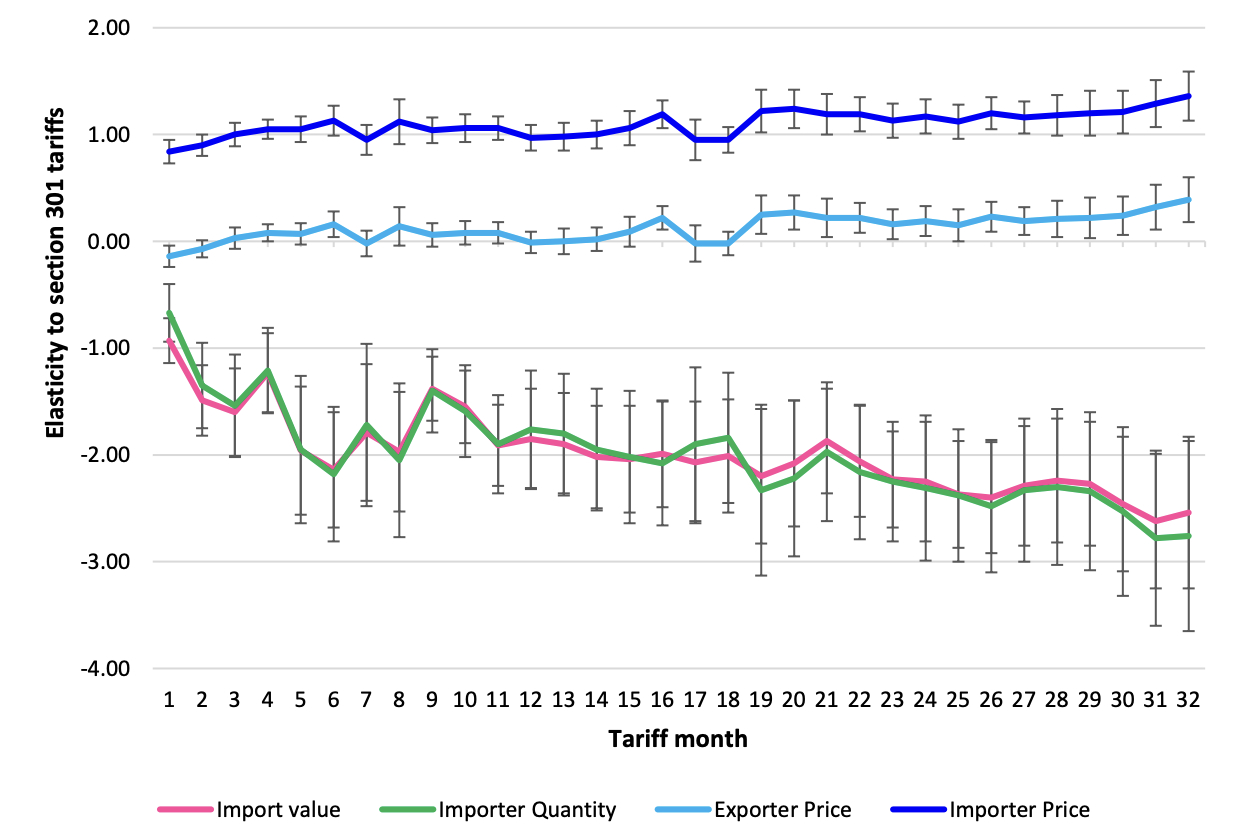
Figure 1. Estimated sensitivity of import trade statistics to Section 301 tariffs. The USITC estimates that increases in tariff rates reduced import quantities and import values while raising importer prices, with the effects on imports becoming stronger over time.
The US-China trade war is a geopolitical struggle deeply rooted in mutual distrust. While tariffs and export bans might seem like a straightforward way to protect national interests, they are actually symptoms of a dangerous paranoia. As history knows all too well, treating the global economy like a zero-sum game only leads to mutual economic decline. Unrestricted suspicion will not restore America's uncontested industrial monopoly, nor will it solve China's fears of being contained. Unless both powers learn to communicate and adapt rather than endlessly building walls, they risk capping their own economic potential and sleepwalking into the same catastrophe that drained Europe a century ago.10
Notes
- Westad, Odd Arne. "Sleepwalking Toward War: Will America and China Heed the Warnings of Twentieth-Century Catastrophe?" Foreign Affairs 103, no. 4 (July/August 2024): 78–89. ↩
- Kennedy, Paul. The Rise of the Anglo-German Antagonism, 1860–1914. London: Allen & Unwin, 1980. ↩
- Wu, Zhengyu. "The Crowe Memorandum, the Rebalance to Asia, and Sino-US Relations." Journal of Strategic Studies 39, no. 3 (2016): 389–416. https://www.tandfonline.com/doi/abs/10.1080/01402396.2015.1112836. ↩
- Westad, Odd Arne. "Sleepwalking Toward War: Will America and China Heed the Warnings of Twentieth-Century Catastrophe?" Foreign Affairs 103, no. 4 (July/August 2024): 78–89. ↩
- D'Agostino, Giorgio. "Escaping the Deadly Embrace: Encirclement at the Origins of World War I." Working paper, Stanford Freeman Spogli Institute for International Studies. https://fsi-live.s3.us-west-1.amazonaws.com/s3fs-public/draft_encirclement_at_the_origins_of_world_war_i.pdf. ↩
- Westad, Odd Arne. "Sleepwalking Toward War: Will America and China Heed the Warnings of Twentieth-Century Catastrophe?" Foreign Affairs 103, no. 4 (July/August 2024): 78–89. ↩
- Westad, Odd Arne. "Sleepwalking Toward War: Will America and China Heed the Warnings of Twentieth-Century Catastrophe?" Foreign Affairs 103, no. 4 (July/August 2024): 78–89. ↩
- U.S. Department of Commerce, Bureau of Industry and Security. “Commerce Implements New Export Controls on Advanced Computing and Semiconductor Manufacturing Items to the People’s Republic of China (PRC).” October 7, 2022. https://www.bis.gov/press-release/commerce-implements-new-export-controls-advanced-computing-semiconductor-manufacturing-items-peoples ↩
- U.S. International Trade Commission. “Certain Effects of Section 232 and 301 Tariffs Reduced Imports and Increased Prices and Production in Many U.S. Industries.” March 15, 2023. https://www.usitc.gov/press_room/news_release/2023/er0315_63679.htm ↩
- Westad, Odd Arne. "Sleepwalking Toward War: Will America and China Heed the Warnings of Twentieth-Century Catastrophe?" Foreign Affairs 103, no. 4 (July/August 2024): 78–89. ↩
Enjoyed this article?
Subscribe to get the latest economic analysis delivered to your inbox.
Comments
Related Articles

Why Is Everything So Expensive?
From inflation and housing shortages to gas prices and corporate pricing, here's what's really driving the rising cost of living.

What Gives Money Value?
You use it practically every day, but at the end of the day, it's just a piece of paper. An apple has tangible value-you can eat it. What...

Beyond Competition: Understanding the Forces Behind "The China Squeeze"
China’s manufacturing dominance is squeezing both developing and advanced economies by limiting their opportunities to build competitive...